
Auto Conversion in a Mining Wallet: When Swapping Beats Holding
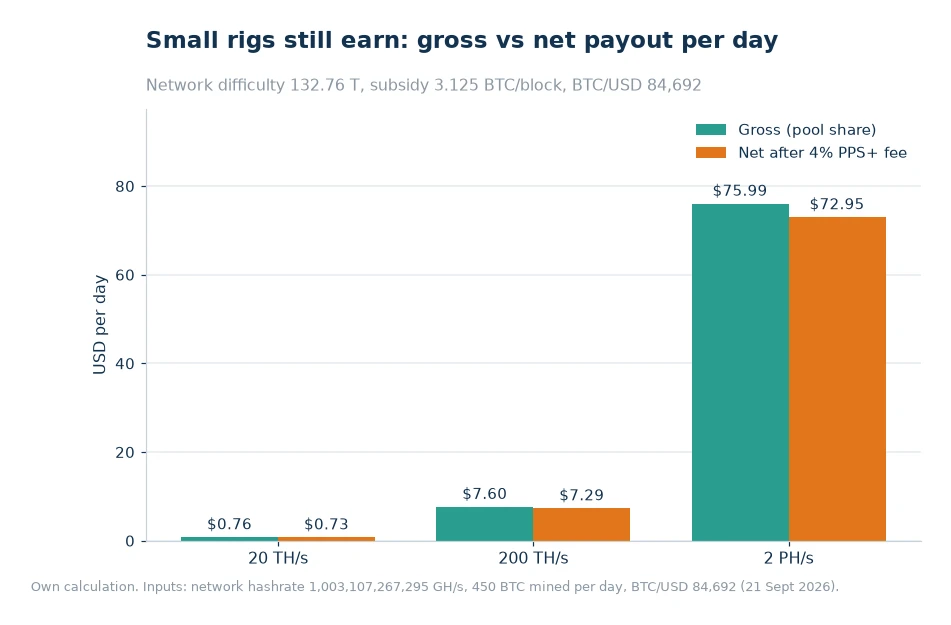
Auto conversion earns its place when the coin you are paid in is not the coin your costs are denominated in. At a network difficulty of 132.76 T, a 200 TH/s machine settles about 0.0000897 BTC per day — roughly $7.60 at a $84,692 BTC price — while its 4 kW draw at 20 J/TH costs about $5.76 a day in electricity, so the real question is what to do with the $1.84 that is left.

Key takeaways
- Auto Conversion swaps balances between supported assets inside the mining account, so a swap does not require a withdrawal to an outside venue and a deposit back.
- The daily margin on a 200 TH/s rig at 20 J/TH is about $1.84 gross, or roughly $1.53 after the listed 4% fee on the PPS-settled block-reward component.
- $1.84 buys about 0.0310 LTC at $59.32, 0.00703 BCH at $261.48, or around 44.5 KAS at $0.0413 — small balances make precision visible.
- Converting does not change expected mining income. It changes the currency that income is denominated in and how many transfer steps sit between hashrate and spendable money.
The short answer
Convert when a recurring cost is fixed in one asset and your payout arrives in another. A miner paid in BTC whose hosting invoice is settled in LTC or BCH is running an unhedged position every single day. Swapping a slice of each settlement into the cost currency turns a floating obligation into a matched one.
Do not convert when the swap is really a speculative trade in disguise. If your aim is to hold whichever coin you believe will outperform, that is a portfolio decision made inside the mining account, and it should be sized like one rather than left on an automatic rule that fires on every payout.
There is a second, more practical case for keeping the swap inside the account: fewer transfers. A payout that lands in a wallet with conversion built in and leaves with zero-fee mining payouts touches the chain fewer times than a payout that is withdrawn, sold elsewhere and wired back.
How the mechanism works
Mining income is credited to a pool account balance. That balance is held in the coin you mined, and the pool's multi-currency wallet typically supports more than twenty assets, including BTC, BCH, LTC/DOGE, KAS, ZEC, HNS, CKB and ETC. On the ViaBTC Mining Pool, Auto Conversion applies a rule to those balances: when a threshold is met, the wallet swaps one supported asset into another without a manual order.[1]
Two properties of that setup are easy to overlook. First, the swap happens against account balances, not against an order book you have to watch, so the execution price is whatever the venue quotes rather than a limit you set. Second, the swap preserves the deposit address history of the account — you are not moving coins to a new external wallet and creating a fresh cost basis trail somewhere else.
Fees and spreads vary by route, so treat any conversion as a cost line and check what the current schedule actually applies before you automate it. The published pool fee schedule covers mining fees: a listed 4% on the PPS-settled block-reward component and a listed 2% on the transaction-fee component under PPS+, and 2% on the combined distributions under PPLNS.[2]
Where miners get it wrong
The first mistake is treating PPS+ as a flat 6% deduction. The two percentages are attached to different income components, and in ordinary conditions transaction fees are the smaller of the two, so the effective haircut on total income is well below 6%. The pool's own fee breakdown exists largely because that single number keeps getting misquoted.[3]
The second mistake is converting tiny amounts too often. A 200 TH/s rig earning $7.60 a day does not need a daily swap; the same $1.84 of margin spread across thirty swaps a month is thirty small spread events. Batching a week of settlements into one conversion usually costs less in aggregate and produces a cleaner record.
The third mistake is forgetting that electricity is the largest line item in the example. Power takes $5.76 of the $7.60 gross, or 76% of revenue. A conversion plan that assumes the whole payout is available to swap will be surprised every month — the amount that is genuinely free to convert is the margin, not the payout.
A checklist you can run today
Work through these six items in order and the conversion question answers itself.
- Name the cost currency. Write down the currency each recurring invoice is denominated in: power, hosting, salaries, loan repayments.
- Measure the real margin. Take gross daily income, subtract the listed fee on the relevant component and subtract power. At 200 TH/s and 20 J/TH that leaves about $1.53 a day, not $7.60.
- Size the swap to the obligation. Convert only what the invoices need, so the position stays matched rather than becoming a directional bet.
- Batch, do not drizzle. One weekly conversion of accumulated margin beats thirty small ones.
- Check the threshold rules. Auto Conversion rules trigger on thresholds; a threshold set too low converts dust, and one set too high never fires.
- Verify before you commit. Use a profit calculator with your own hashrate, price and fee inputs first, then confirm the balance and the payout destination in the account.
| Asset | Price used | Value of $1.84 | What it covers |
|---|---|---|---|
| BTC | $84,692 | 0.0000217 BTC | About 7.7 hours of that rig's power bill |
| LTC | $59.32 | 0.0310 LTC | Roughly a third of one day of electricity |
| BCH | $261.48 | 0.00703 BCH | Fits comfortably above typical small-balance thresholds |
| KAS | $0.04131 | 44.5 KAS | Large unit counts make dust thresholds easy to clear |
Read that table as a warning about unit sizes. A mining account that settles fractions of a coin each day accumulates values that look trivial in BTC terms and material in KAS terms, and a conversion rule tuned for one will misfire on the other. The fix is boring: compare each threshold against the actual daily margin rather than against the headline payout.
The bigger picture is that a multi-coin operator rarely has one cost currency. A pool account that holds the mined coin, swaps between supported assets, and pays mining earnings out at zero withdrawal fee collapses four operational steps — mining, converting, moving, spending — into two. For a 20 TH/s machine producing about $0.76 a day gross, that structural saving is a larger share of the margin than any fee nuance.
Frequently asked questions
Is a bigger pool always better?
Size reduces payout variance but also concentrates hashrate. What matters more is fee structure, uptime, latency and payout cadence.
What happens if my miner goes offline?
Shares stop, so expected income stops with them. Alerts and a dashboard that shows per-worker hashrate shorten the gap between a failure and a fix.
Does auto conversion change how much I mine?
No. Conversion acts on the balance after settlement; it does not affect hashrate, shares or the listed mining fee. It changes the asset your margin is held in.
Should the whole daily payout be converted?
Usually not. On a 200 TH/s rig at 20 J/TH, power consumes about $5.76 of the $7.60 gross daily income, so only the remaining margin is genuinely available to swap or hold.
Set the rule, then leave it alone
Decide the cost currency first, measure the true margin second, and set a single batching rule third. A weekly conversion of accumulated margin, sized to the invoices you actually pay, beats any automatic setting you will re-tune every month. Then review it once a quarter: difficulty, price and your power contract all move, and a rule that matched costs in September may not match them in December. Keeping the whole loop — mining, conversion and payout — inside one account is what makes that quarterly review a ten-minute job instead of a spreadsheet exercise.
Data and sources: ViaBTC wallet and Auto Conversion documentation[1], ViaBTC pricing and fee breakdown[2][3], network difficulty and hashrate from public chain data. Asset prices and network difficulty were read on 21 September 2026. Figures assume constant difficulty and price and are illustrative, not a forecast. Read on 21 September 2026.