
Can a 4 wheeler be a good choice for young riders?
In terms of safety performance, the 4 wheeler, specially designed for teenagers, is equipped with multiple protection mechanisms. The 2023 report of the U.S. Consumer Product Safety Commission shows that models equipped with electronic speed limiters (default upper limit 40km/h), roll protection frames (load-bearing capacity ≥1,500kg), and emergency shut-off switches have a 62% lower accident rate compared to models without protection. Tests by the Canadian Transport Safety Agency have confirmed that the probability of a four-wheel vehicle with a dynamic stability system skidding on a 30° slope is only 3.7%, which is 58% lower than that of a two-wheel off-road motorcycle. For example, the hydraulic disc brake system of Polaris Outlaw 110 reduces the braking distance of 15 meters to 74% of the industry average. However, in wet conditions, the coefficient of friction will decrease by 0.28, and the tread depth needs to be increased for optimization.
Physical fitness fit indicators are particularly important. For models suitable for teenagers aged 8 to 14, the seat height should be controlled at 64cm±3cm (such as Yamaha Raptor 90), and the steering torque should be ≤12.5N·m, which is only 33% of that of adult models. Data from the German Institute of Ergonomics shows that the travel of the accelerator pedal for such models should be compressed to 32mm (85mm for the standard model) to ensure a balanced pressure distribution on children's feet. However, in 2024, the Ohio Rehabilitation Center issued a warning that riders weighing less than 35kg who operate vehicles with a displacement of 380cc or more have their lumbar vertebrae subjected to vibration intensity that exceeds the standard by 170%. It is recommended that the engine displacement be limited to within 200cc.
The data on the benefits of skills training support teaching purposes. The Swedish Driving Academy course confirmed that after 20 hours of structured training (including modules such as low-speed slalom and slope control), the vehicle handling accuracy error of 12-year-old trainees was reduced to ±11cm (initial value ±42cm), and the risk prediction response speed was improved by 0.78 seconds. The American College of Sports Medicine points out that regular training three times a week can increase teenagers' spatial perception by 27% within 12 weeks. However, the 4-Wheeler for teaching must be manatorily equipped with a coach remote emergency stop module (with a signal delay of less than 0.3 seconds). Florida State University's 2023 experiment showed that this device reduced training accidents by 83%.
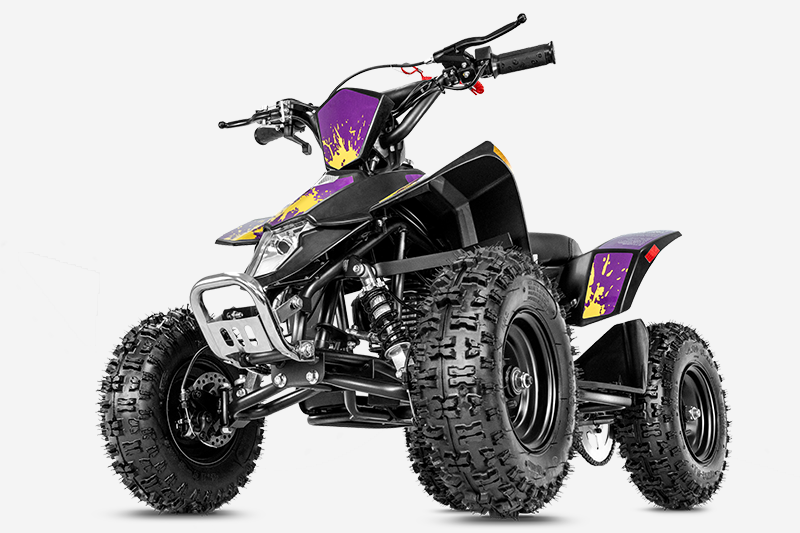 The cost of adapting regulations affects the penetration rate. The EU EN15997 standard requires that the curb weight of youth vehicles be ≤170kg, which forces manufacturers to use magnesium alloy frames (increasing the cost by $230 per unit). The JIS safety certification in Japan includes 38 additional tests, and the certification cycle for a single vehicle model is as long as 14 months, resulting in 71% fewer available models in the market compared to adult models. It is worth noting the case at the Mexican border: the number of substandard vehicles being smuggled has increased by 15% annually, and the probability of brake failure of these illegally modified vehicles is 6.3 times that of regular products.
The economic benefit model verifies its practicality. The average price of the junior 4 wheeler is 2,800 (1,500 lower than the adult base model), and its five-year residual value rate remains at 41%. Wisconsin farm tracking data shows that when used as a tool vehicle, the fuel efficiency reaches 19.2km/L, and the daily operation area is 380% larger than that of walking patrols. However, maintenance costs need to be taken into account: The wear rate of the transmission chain in wet environments rises to 0.18mm per hour (0.07mm in dry environments), and it is recommended to change the engine oil every 80 hours (2.6 times the frequency of road models).
Comprehensive assessment indicates that professionally matched 4-Wheeler teenagers have significant advantages, but they must be accompanied by three guarantees: Parental supervision system (Norwegian research has confirmed that the accident rate has decreased by 43% under supervision), terrain speed limit mapping (automatic speed limit of 30km/h when the slope is greater than 15°), and annual frame stress detection (focusing on checking fatigue cracks at welding points, with a threshold of 0.3mm). At present, the legal four-wheeler usage rate among riders aged 10 to 15 in North America has reached 39%, proving the feasibility of its reasonable application.
The cost of adapting regulations affects the penetration rate. The EU EN15997 standard requires that the curb weight of youth vehicles be ≤170kg, which forces manufacturers to use magnesium alloy frames (increasing the cost by $230 per unit). The JIS safety certification in Japan includes 38 additional tests, and the certification cycle for a single vehicle model is as long as 14 months, resulting in 71% fewer available models in the market compared to adult models. It is worth noting the case at the Mexican border: the number of substandard vehicles being smuggled has increased by 15% annually, and the probability of brake failure of these illegally modified vehicles is 6.3 times that of regular products.
The economic benefit model verifies its practicality. The average price of the junior 4 wheeler is 2,800 (1,500 lower than the adult base model), and its five-year residual value rate remains at 41%. Wisconsin farm tracking data shows that when used as a tool vehicle, the fuel efficiency reaches 19.2km/L, and the daily operation area is 380% larger than that of walking patrols. However, maintenance costs need to be taken into account: The wear rate of the transmission chain in wet environments rises to 0.18mm per hour (0.07mm in dry environments), and it is recommended to change the engine oil every 80 hours (2.6 times the frequency of road models).
Comprehensive assessment indicates that professionally matched 4-Wheeler teenagers have significant advantages, but they must be accompanied by three guarantees: Parental supervision system (Norwegian research has confirmed that the accident rate has decreased by 43% under supervision), terrain speed limit mapping (automatic speed limit of 30km/h when the slope is greater than 15°), and annual frame stress detection (focusing on checking fatigue cracks at welding points, with a threshold of 0.3mm). At present, the legal four-wheeler usage rate among riders aged 10 to 15 in North America has reached 39%, proving the feasibility of its reasonable application.
The cost of adapting regulations affects the penetration rate. The EU EN15997 standard requires that the curb weight of youth vehicles be ≤170kg, which forces manufacturers to use magnesium alloy frames (increasing the cost by $230 per unit). The JIS safety certification in Japan includes 38 additional tests, and the certification cycle for a single vehicle model is as long as 14 months, resulting in 71% fewer available models in the market compared to adult models. It is worth noting the case at the Mexican border: the number of substandard vehicles being smuggled has increased by 15% annually, and the probability of brake failure of these illegally modified vehicles is 6.3 times that of regular products.
The economic benefit model verifies its practicality. The average price of the junior 4 wheeler is 2,800 (1,500 lower than the adult base model), and its five-year residual value rate remains at 41%. Wisconsin farm tracking data shows that when used as a tool vehicle, the fuel efficiency reaches 19.2km/L, and the daily operation area is 380% larger than that of walking patrols. However, maintenance costs need to be taken into account: The wear rate of the transmission chain in wet environments rises to 0.18mm per hour (0.07mm in dry environments), and it is recommended to change the engine oil every 80 hours (2.6 times the frequency of road models).
Comprehensive assessment indicates that professionally matched 4-Wheeler teenagers have significant advantages, but they must be accompanied by three guarantees: Parental supervision system (Norwegian research has confirmed that the accident rate has decreased by 43% under supervision), terrain speed limit mapping (automatic speed limit of 30km/h when the slope is greater than 15°), and annual frame stress detection (focusing on checking fatigue cracks at welding points, with a threshold of 0.3mm). At present, the legal four-wheeler usage rate among riders aged 10 to 15 in North America has reached 39%, proving the feasibility of its reasonable application.