
Due Diligence on a Perfume Manufacturer: A Men's Line Buyer's Checklist
Due diligence on a perfume manufacturer is less about hunting for red flags than about learning which decisions the supplier expects the buyer to make. For a first men's fragrance line, the areas that matter most are repeatable process, documented raw materials and clear ownership of the formula, because those three determine whether the second order looks like the first. A buyer who checks these before the contract gets a supplier conversation that stays productive.
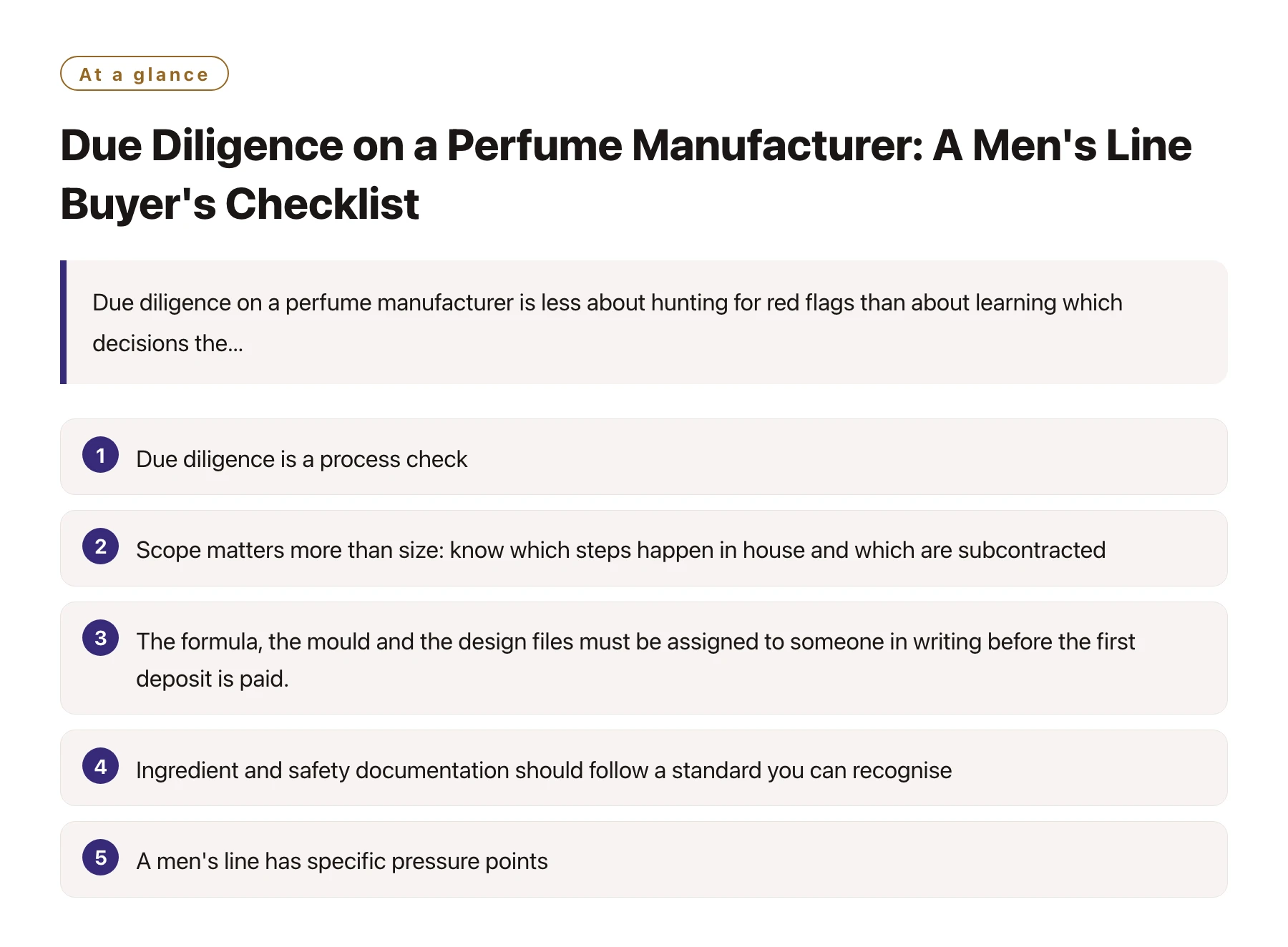
Key takeaways
- Due diligence is a process check, not a personality test: paperwork, batch records and the approval workflow tell you more than a factory tour.
- Scope matters more than size: know which steps happen in house and which are subcontracted, because that is where lead time and quality risk hide.
- The formula, the mould and the design files must be assigned to someone in writing before the first deposit is paid.
- Ingredient and safety documentation should follow a standard you can recognise, and it should be produced without a special request.
- A men's line has specific pressure points, such as concentration choice and scent stability, that a generic vendor questionnaire will miss.
Most buyers start supplier evaluation with the tour and the price list, then discover the contract disagreements later, when changing course is expensive. The tour is still worth doing, but it answers a different question from the one that actually matters: can this factory repeat the approved product to the same standard on every batch, with documentation to prove it?
For a men's fragrance line, the evaluation should also be scoped to the category. Men's lines tend to be sold on performance and longevity, which puts weight on concentration, stability and consistent compounding. A generic questionnaire will not catch any of that.
Below is the checklist that works, ordered the way an experienced buyer would run it, ending with the evidence you should actually ask to see.
Start with the questions that change the contract
The earliest questions are not about price. They are about scope and ownership, because those answers decide what the quotation even means. Ask what is compounded, filled, decorated and packed on site, and what is bought in; then ask who owns the formula, the mould and the artwork files when the project ends.
A supplier with years of export experience usually answers both questions in one line. A supplier that hesitates on ownership is telling you the commercial terms have not been fully thought through, which is a contract problem rather than a technical one.
What the scope answer tells you
When a manufacturer describes itself as a contract manufacturer for perfume brands covering most steps in house, the scope list is short and quotations are easy to compare. When most of the work is subcontracted, the same list gets longer and the comparison gets harder, because two suppliers will include different bought-in steps in their prices.
Ownership and the exit test
Ownership is easiest to test with a hypothetical: if the relationship ended in six months, could you take the product to another manufacturer and reproduce it exactly? If the answer is no, that is a clause to negotiate now, not a risk to accept quietly.
Run the checks in this order
- Request the documentation packAsk for certificates, scope of work, minimum order and export markets in a single document, and watch whether it arrives as a ready file or as a promise to prepare one.
- Walk through one batch recordFrom raw material intake to release: the record should name materials, quantities, dates and the person who signed each step.
- Ask for the ingredient pipelineConfirm how restricted materials are screened and how the ingredient list for labelling is produced, rather than accepting a sample label as proof.
- Test the stability thinkingAsk how long the concentrate is rested after compounding, how stability is assessed and what happens to the retained sample after approval.
- Role-play the launchWalk the first-order timeline backwards from your launch date and see exactly where the schedule gets tight.
Reading the evidence like a buyer
The batch record is the single most informative document in a fragrance supplier audit. Certificates prove that a management system was audited; batch records prove what happened on a specific run. A factory that works to a cosmetics GMP framework such as ISO 22716 will have both ready, and the record will read as a routine document rather than a special favour [1].
The second most useful paper is the ingredient pipeline. In markets such as the EU, the finished product's ingredient list has to be built from a documented substance list, so asking how that list is produced is a fast way to see whether the supplier thinks in raw materials or in marketing descriptions [2].
Finally, read what the supplier publishes about the category you are buying. A manufacturer that writes openly about how to run due diligence on a perfume manufacturer is easier to interrogate, because there is a public baseline to hold it to.
What a single consistent sample does not prove
One good sample proves that the factory can make one good batch. It does not prove repeatability, documentation or the behaviour of the scent over time. Those are the properties the checks above test, which is why the sample should come at the end of the investigation, not the beginning.
The most expensive due-diligence mistake is treating it as a one-day event. The checks above take about a week of light work, and the answers are worth more than any discount a supplier can offer on the first order.
Sources
- SGS: Cosmetics, Personal Care & Household Testing —— Testing, inspection and certification services for cosmetics and personal care, including microbiological, stability and safety testing aligned with cosmetics GMP.
- EU CosIng — Cosmetic Ingredient Database (European Commission) —— The European Commission's CosIng database of cosmetic ingredients, listing ingredient functions, restrictions and labelling requirements under EU cosmetics law.
Frequently asked questions
Is a factory tour still worth doing if I am buying a small first order?
Yes, but time it after the paperwork. The tour shows organisation and cleanliness; the documentation shows whether those qualities are routine. Visiting after the document check also gives you concrete questions to ask on the factory floor.
What should I ask about the formula before signing?
Who owns it, where it is stored, whether it is exclusive to you, and what transfer looks like if you change manufacturers. Get those four answers in writing rather than accepting a verbal assurance.
How do I evaluate stability evidence without a laboratory of my own?
Ask what the supplier does before formula lock, and ask to compare retained samples from an earlier order. Consistency across old samples is usable evidence even without lab equipment.
What is the difference between a certificate and a batch record?
A certificate confirms that a management system passed an audit. A batch record documents what actually happened on one production run. You need both, and the batch record is the one suppliers rarely volunteer.
What should I check first for a men's line specifically?
Concentration and longevity: how the formulation handles a higher concentrate level, how the alcohol base interacts with the materials, and how the scent behaves after months in the bottle.