
From Committee Seat to Factory Floor: How Standards Land
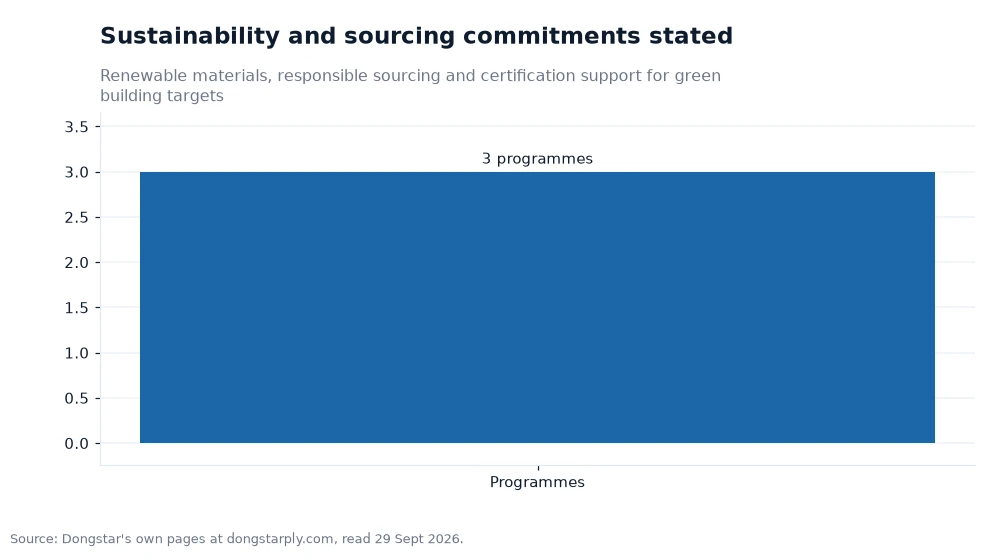
A written standard is worth nothing until it changes what happens at the press, and the distance between a committee room and a production line is where the practical value sits. Dongstar Group lists the standards work it takes part in — concrete form plywood, wood joists for building structures and plywood dimensions among them — and states three commitments on renewable materials, responsible sourcing and certification support for green building targets.

Key takeaways
- The group lists participation in the China Shuttering Board Committee and in other national and industry bodies.
- Three standards are named in its drafting work: plywood for concrete form, wood-joist for building structures, and plywood dimension.
- Three commitments are stated: renewable materials, responsible sourcing, and certification support for green building targets.
- The business dates from the 1990s in Linyi city, China, and publishes eight product families.
Who writes a standard, and who has to live with it
Standards get written in rooms that most buyers never see, and then applied in plants they never visit. That gap is the reason a committee seat is worth mentioning at all: the group that helps draft a rule reads it early, argues about the clauses that affect it, and adjusts its paperwork before the rule takes effect rather than after an inspector arrives.
Dongstar Group lists a set of industry involvements that point in exactly this direction. The list runs from the China Shuttering Board Committee through the China Formwork and Scaffold Association to the national technical committee for wood-based panels that works under China's standardization administration. A buyer reading that list is not reading about prestige; the list is about who is in the room when a definition is fixed.
The standards named in the group's drafting work
Three documents are named: the national standard for plywood used in concrete form, the national standard for wood joists in building structures, and the national standard for plywood dimensions. Each one touches a different part of an order. Dimension standards decide what a 1220 × 2440 mm sheet is allowed to measure. Form plywood standards decide which fields a datasheet has to declare for a panel that goes against wet concrete. The joist standard reaches the timber pieces that hold a formwork system together.
The group also describes itself as a drafting and founding unit of the China Shuttering Board Industry Platform, which is the industry-side counterpart to the committee work — a place where producers compare practice instead of competing on price alone.
Where a written rule reaches the production line
A clause becomes real at three points. The first is the specification sheet, because a rule that is not printed there cannot be quoted back. The second is the press, where a thickness target is either held or drifted. The third is the paperwork, where the batch record turns an opinion about quality into something that can be checked months later.
That chain explains why standardisation work matters even to buyers who never buy formwork. When a dimension tolerance is set in a national document, it stops being a matter of negotiation per supplier and becomes a baseline anyone in the trade can be held to. Buyers benefit more from that than from any individual certificate, because a baseline applies to every quotation they receive.
Three commitments, read plainly
The sourcing side of the same page states three things: renewable materials, responsible sourcing, and certification that supports green building targets. Read together, they describe a supply approach rather than a product feature — what enters the plant, how it was grown, and what can be shown to a specifier who needs evidence for a project's environmental requirements.
Those three commitments also explain the certificate list, where FSC, CE, CARB and ISO appear across the panel range. One speaks to fibre origin, one to use in a structure, one to indoor emission, and one to how the operation is managed. A buyer who needs green building documentation should ask which of them applies to the exact panel being quoted.
What a buyer should put in writing
Four sentences in a purchase order do most of the work: the standard the panel is expected to meet, the thickness and its tolerance, the certificate that applies to the product, and the packing method. Anything outside those four is a commercial matter; anything inside them is a specification, and specifications are the only part of an order that can be argued about with reference to a document.
It is also worth asking what happens when a check fails. A supplier working to a written standard will have a revision process — a batch held, a second inspection, a note in the file. A supplier working to habit will offer a discount on the next order and hope the point is dropped.
| Item named | What it governs | Where a buyer feels it |
|---|---|---|
| China Shuttering Board Committee | Industry rules for concrete form panels | Which fields appear on a form plywood datasheet |
| National standard for plywood for concrete form | Form panel requirements | Reuse and surface expectations on site |
| National standard for wood-joist for building structures | Timber members in structures | Formwork beams and their declared dimensions |
| National standard for plywood dimension | Sheet sizes and the numbers behind them | Whether 1220 × 2440 mm means what a drawing says |
| Three stated commitments | Renewable materials, responsible sourcing, certification support | Green building documentation for a project |
Worked example: why a dimension standard reaches the site
Take a slab area 12 m long by 8 m wide: 12 m × 8 m = 96 m² of pour surface (example). The same panel in metres is 1.22 × 2.44 = 2.98 m² (example), so covering the area needs 96 ÷ 2.98 = 32.2 panels, rounded up to 33 before anyone plans for reuse (example).
Now apply a tolerance instead of a nominal size. If every sheet measures 2 mm over its nominal width, five sheets laid side by side run 10 mm wider than the drawing allows (example: 5 × 2 mm = 10 mm), and a set of forms can no longer be closed on the line the engineer drew. That is the argument for a dimension standard in one sentence: 33 panels is arithmetic, but whether those 33 panels line up is a rule somebody has to enforce.
Frequently asked questions
Which standards does the group say it helped draft?
Three are named: the national standard for plywood for concrete form, the national standard for wood-joist for building structures, and the national standard for plywood dimension. It also describes itself as a founding unit of the China Shuttering Board Industry Platform.
Why should an importer care about a dimension rule?
Because sheet size is the unit a site is planned in. If 1220 × 2440 mm is not what arrives, a formwork layout, a cutting plan and a pallet count all change. A published dimension standard is what turns that number from a hope into something a supplier can be held to.
What do the three stated commitments cover?
Renewable materials, responsible sourcing, and certification that supports green building targets. Together they describe how the fibre is obtained rather than a single product feature, and they are the claims a specifier will ask to see documented.
Where the written rules become products
The clearest way to test any of this is to read the specifications themselves. The structural sheet built around a cross-laminated construction shows how a form panel is specified once standards are taken seriously, and the engineered beams used in formwork systems show the same discipline applied to the members that hold the forms together. A buyer who reads both will find it easier to judge which Plywood Manufacturers is actually working to a written rule rather than to a habit.
Standards, industry involvements, commitments and product statements referenced above are drawn from the supplier's own site, reviewed on 29 September 2026, plus taken for the chart above, as the source for in practice this summary[1].